Close

Salamander House

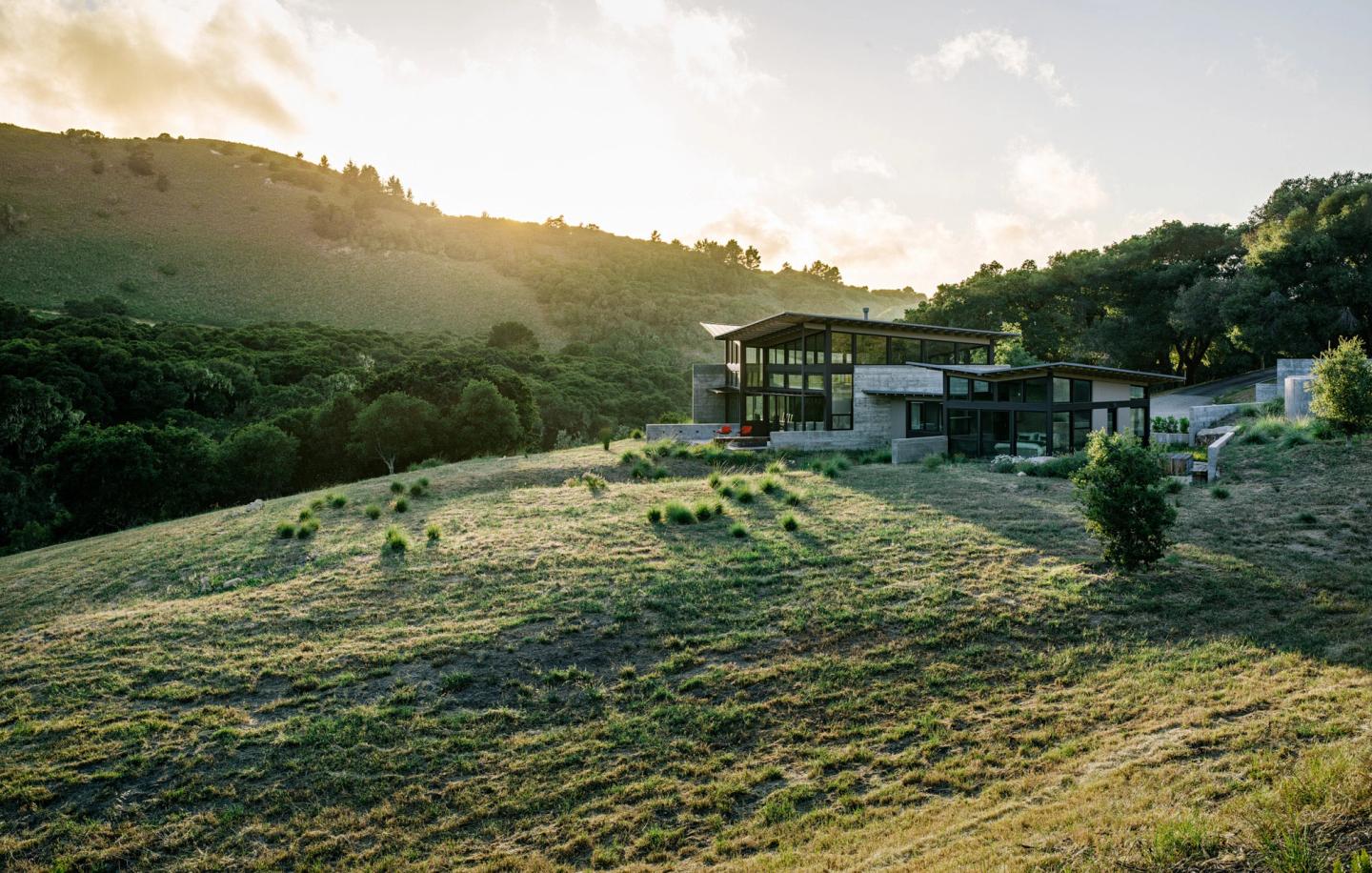
The Salamander House is a family retreat nestled amidst the grazing livestock of a thriving walnut farm in the Central Valley near the San Andreas fault.  The long, gently arching house is situated at the base of hills and responds to the curve of the land's contours, opening up to views of more distant hills to the east.  Light glass boxes contain the main living areas and frame views and open up to private outdoor living spaces.  The light-filled boxes are anchored by three massive rammed earth walls of vibrant color.  The palette of wood, glass, steel and concrete creates a modern compliment to the artisanal rammed earth walls with their bold undulating layers. 

A LEED Gold candidate, the house harnesses geothermal energy that feeds a radiant heating and cooling system.  The loads on the system are minimized through passive heating and cooling techniques: the thermal mass of concrete floors and rammed earth, overhanging roofs, and south-east facing glazing.  This all-electric house offsets its energy consumption with a photovoltaic system and a solar thermal array for water heating.  Reclaimed siding, flooring and sustainably harvested woods can be found throughout the house.  The landscape around the house is planted with drought tolerant flora and native grasses. 

CONTRACTOR: Stocker & Allaire
LANDSCAPE ARCHITECT: Bernard Trainor + Associates
STRUCTURAL ENGINEER: Yu Strandberg Engineering
MECHANICAL ENGINEER: Monterey Energy Group
RAMMED EARTH CONSULTANT: Benchmark Development


GREEN FEATURES 

Site and Landscape

Non-invasive plants

Compact development leaving the majority of the site undisturbed

98% of site is permeable; impermeable surface run-off is directed to on-site retention/infiltration areas


Water Efficiency

Reduce irrigation demand by 70% using native, drought-tolerant landscaping

Low flow bathroom toilets


Passive Solar Heating and Cooling

Exposed concrete floors and rammed earth walls form a thermal mass that absorbs heat from daytime sun and release it slowly during the cool nights

Glazing has .3 U-factor and .27 Solar Heat Gain Coefficient (SHGC) to maximize passive solar gain, but minimize harmful UV rays

Cross ventilation and ceiling fans for cooling

Shading slats at tall windows with direct sun exposure reduce the load on the active cooling system during hot days.

Deciduous trees and a planted shade trellis at the south end of the home help to reduce solar heat gain during the summer and allow it during the winter

Air leakage minimized with blown-in, bio-based insulation

Insulated, recirculating hot water system

Exceeds by 49% the Title-24 requirements 

EnergyStar rating for thermal bypass system


Energy Efficient Active Systems

Integrated photovoltaic panel system produces 62% of annual energy requirements

Solar thermal array for water heating

Geothermal ground source heat pump draws warmth from the temperature below ground to heat the hydronic radiant floor during the cold winter months and runs in reverse to act as a heat sink and cool the floors during the hot summer months  

The radiant floor heating & cooling system is zoned to reduced distribution loss 

Energy efficient appliances and lighting


Sustainable Materials

Low embodied energy materials (locally sourced and/or recycled content):

Rammed earth walls formed with 533 tons of local soil (76% of the total earth used)

Reclaimed western red cedar siding

25% Fly ash content in structural footings and slab

Recycled composite quartzite countertops

Sustainably harvested (FSC certified) wall framing, cabinetry and interior trim

Efficient framing techniques: stud and joists spaced at 24” O.C.

Reduced waste generation by 91% from typical construction


Indoor Air Quality

Natural ventilation: windows designed for cross ventilation

No forced air HVAC system 

Low formaldehyde and low VOC materials used throughout

Exhaust fans in bathrooms & kitchen

Sealed garage from adjacent living spaces

EnergyStar rating for indoor air package
Close
EMAIL THIS IMAGE
Email Photo
Show Details
  • 1
  • 2
  • 3
  • 4
  • 5
  • 6
  • 7
  • 8
  • 9
  • 10
  • 11
  • 12
  • 13
  • 14
  • 15
  • 16
  • 17
  • 18
  • 19
  • 20
  • 21
  • 22
  • 23
  • 24
  • 25
  • 26