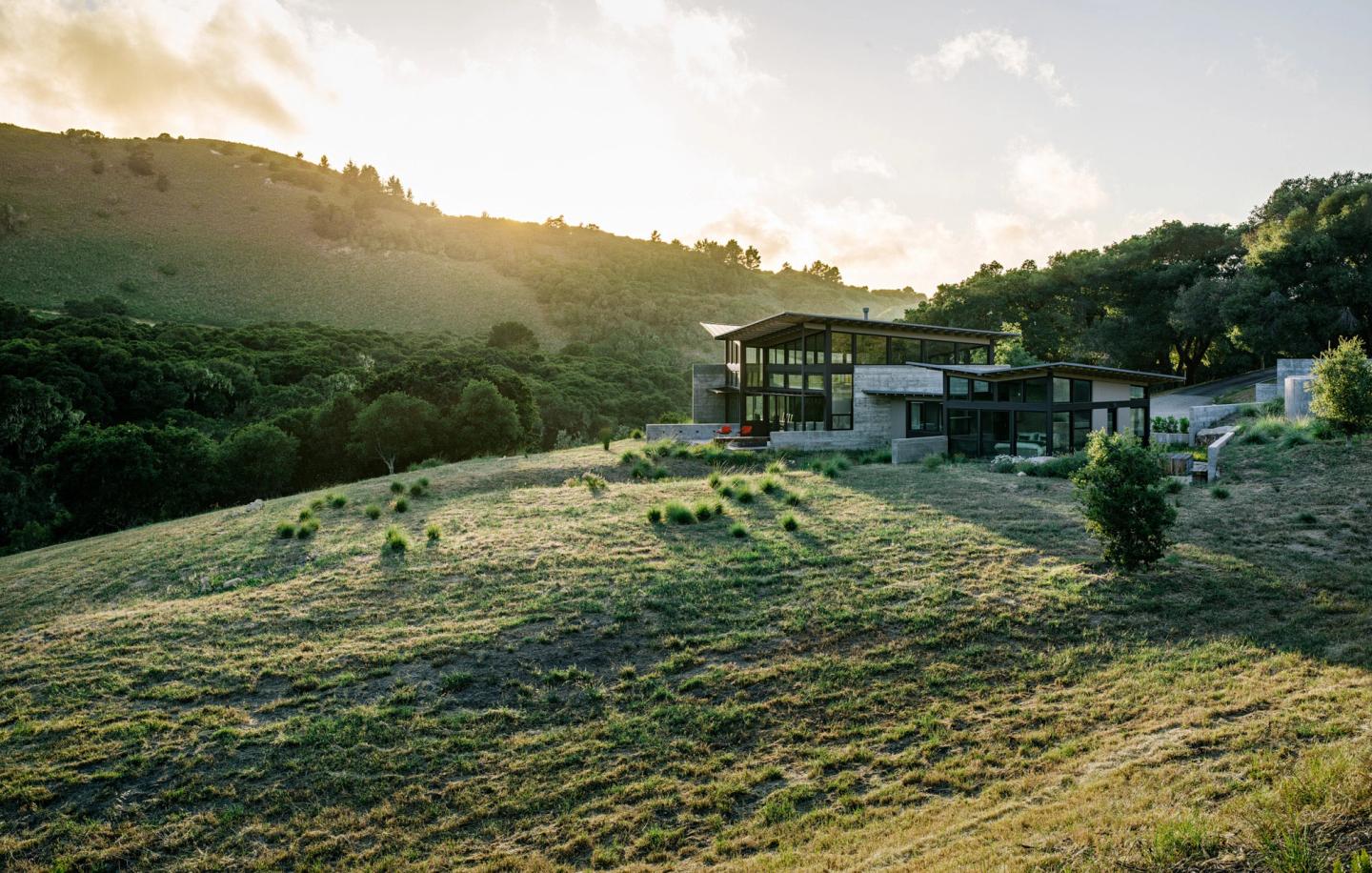
This fall finds Feldman Architecture staff cozying up in our new digs at Levi’s Plaza and delving into some amazing projects. Our office move and remodel is nearing completion, as complete as a project can be within the design profession! We’ve received artwork from Catherine Wagner and Meghan Urback, and we’re looking forward to a few final pieces of artwork and furniture. In the past few months, our social media presence continues to spread, bolstered by a Q&A session on “The Architect Is In” by Remodelista which featured the Old Bernal Remodel with Jonathan revealing details about the design of the project throughout a weekend in August. We were also fortunate to be featured on Forbes.com with an article discussing the increasingly popular residential green roof. In print, Elle Décor featured the Mill Valley Cabins in an article about yoga rooms. Feldman Architecture’s Pacific Heights Townhouse turned up in the recently released 21st Century Architecture: Designer Houses by Mark Clearly, and the Caterpillar House is featured in Passive Houses: Energy Efficient Homes by Chris van Uffelen. Last month, Jonathan presented an introductory architecture class to technology and media leaders entitled ‘Cool or Craptastic.’ We enjoyed bombarding Jonathan with our thoughts on cool and craptastic buildings – not that architects have opinions! Most recently, we learned that the eco+historical Vistorian Update here in San Francisco and a collaboration with eco+historical earned LEED Platinum status. And just this month, we completed photography of the Forest Hills remodel (image above). We continue to grow and have exciting additions in our staff. This summer, we gladly welcomed Caroline Arpa and Nick Riker to our team – check out their bios on our staff pages. And we are very pleased to share that Lindsey, Travis, and Lucie Theobald welcomed Elle Tamsin to their family on August 16th. We’re wishing Lindsey the best in her 4 month leave with plenty of girl time!
Tools of the Trade - Part 2
As our office moves almost entirely to Revit where we are building a complex 3D Model for each project, we find ourselves relying on new and old tools to more efficiently convey design ideas. Recently, we compared notes on methods for sketching. Sketching by hand gets us away from the computer for a bit and lets the hand, head and drawing all connect. The energy and feeling that comes across in a sketch is also key and difficult to produce with a computer model.
Many of us rely on the old methods of trace and pen or pencil to create layers of options on top of a base drawing and watch how an idea unfolds and develops. We find that our clients respond well to the openness of a sketch where we can commit to paper the key components that we know but leave unanswered questions open. It is also effective to pair these sketches with evocative precedent images which help to fill in some of the blanks. Finally, many of us sketch in axonometric in order to figure out exactly how a construction detail is going to come together.
Jonathan brought to the table two iPad programs which are easy to use and offer a lot of options for sketching while on the go or in those few minutes between meetings. Both offer the ability to create multiple versions of a drawing and to send them out to a project team quickly by email. Jonathan recommends both programs and finds it sometimes helpful to begin a sketch in the app called ‘Paper’ which allows a loose drawing and then import that sketch into ‘Sketchbook Pro’ where you can get finer lines. Below is a break down of these two programs. We’re now all itching to get our Feldman iPads and start sketching!
Free app which comes with a set number of pen, pencil, and watercolor styles. Additional pen styles are available for about $.99/each Six colors in an appealing palette Ability to export a page by email as jpeg, or post to FB, Twitter, Tumblr, etc. Easy to rewind the drawing backwards when you make a choice you don’t like Takes some learning how the app responds to a finger or stylus since you are not always drawing exactly where the stylus lands and the lines are not super fine. Recommend the purchase of a stylus (approximately $14)
Inexpensive app for the iPad Works much like Photoshop or Illustrator Ability to import and export files via File Share, DropBox, iPad camera or Photo Library. Layers and the ability to adjust or hide them makes it possible to create many iterations using the same base layer(s) Template layers available with perspective and grid lines Lots of different marking tools (pens, line tool, pencils, airbrush, etc.) Many colors available with an RGB wheel
Travel Photos: Ann Arbor
I recently took a quick trip back to my home town of Ann Arbor Michigan. Even though I was on vacation, I couldn’t help but snap a few shots of the architecture in the city. Ann Arbor is composed of nice old university buildings as well as a lot of contemporary architecture.
Caterpillar House Takes California Home + Design Award
Best Residential Architecture (Less than 3,000sf)
On February 1st, we attended the California Home + Design gala where the Caterpillar House picked up an award for residential design. We also learned in January that Caterpillar earned an award for Excellence in Design from the AIA Monterey Bay and was nominated as an Honoree in the Best of Year ceremonies by Interior Design. A hearty congratulation to the many team members who helped realize this stunning, LEED Platinum home. Click the image above to visit the California Home + Design Website for the full article.
An Office on the Move
After March 25th, we will be settling into a new office near Levy Plaza at 1005 Sansome St., Suite 240, San Francisco. While we’ll miss our lively digs in SOMA and the availability of Sight Glass coffee, we’re excited to more than double the size of our space which will feature, a light-filled conference room, a working area with lots of samples, excellent artwork and all your favorite people. We can't wait to show you around!
New Associate and New Addition
We're pleased to announce the promotion of Tai Ikegami to the position of Associate with the firm. Joining Feldman back in 2005, Tai has led several amazing, award-winning projects and helped steward the firm in its growth. On February 20th 2012, Tai, Yuchin and Haruki welcomed a little boy into their family, Hayato Ikegami. Congratulations to Tai and family!
When choosing doors to improve indoor-outdoor connections, we always consider a number of competing objectives and challenges. Among the important considerations are how large do we want individual panels to be, how large of a clear opening are we trying to create, the style of the house, the weather exposure, and the need for insect protection. - Jonathan
House Ocho: 4-panel sliders Here we used two operable and two fixed doors to get a wide opening to the patio. We extended the score lines of the concrete floor inside the house to the outside creating planting strips to emphasize the indoor-outdoor connection. Henry House: 4-Panel Sliders This attic conversion in San Francisco used similar sliding doors to connect to a new roof deck.
Buena Vista: Custom Pivot Doors Custom pivot doors create a nice modern punch in this San Francisco Victorian. We like the way that, when open, the doors provide a directionality that draws one out to the spectacular view beyond.
Old Bernal: Two Large Lift and Slide Doors This oversized lift and slide door is made of two operable panels that provide large openings and flexibility.
Open Box 2: Slide-Fold Doors
These multi-panel doors have a limitation in terms of how wide each door panel can be, but they make up for it in providing a clear, unobstructed opening when the doors are pushed to the side.
What's in a Cabinet?
Walls don’t have to be the only physical separation between rooms or spaces. At Feldman Architecture, we often use cabinetry to define boundaries. Cabinetry adds variation to a room’s palette through the use of different materials, like wood and glass. It also has the benefit of transparency, which isn’t as easily achieved with framed walls. Open shelving and transparent or translucent materials keep a visual connection between rooms, but still help define space. Plus, cabinetry is very useful for storage! Here are a few examples of how we’ve used cabinetry. - Lindsey A combination of etched glass panels and stained wood cabinetry act as a buffet for the Dining Room on one side and a media center for the Family Room on the other side. Transparency plays a big role in making this kitchen cabinetry useful but still keeping a strong visual connection between rooms.
Left: The mixture of materials in this work station keeps the palette interesting. The combination of open shelves and translucent panels provides natural light and give a sense of openness, while still providing necessary storage.
Right: The use of kitchen cabinetry provides useful function, while maintaining a strong visual connection to the Dining Room.
A continuous low cabinet runs the length of the house and even outside, tying the rooms together. Inside it is Kitchen cabinetry, a Dining Room buffet, and Family Room storage. Outside, it becomes the BBQ and food prep station.
Making the Call: The Initial Conversation with an Architect
After months of downloading images to a Houzz.com Idea Book or clipping articles from residential design magazines, you’ve just purchased a spectacular piece of land or an older home and are eager to start your design and construction project. Exciting! But where to begin? When do you start talking to an architect? What can you expect when making that first call?
We share the enthusiasm of our clients as they begin their project, and we often spend the first couple of meetings getting to know you, the site, the program, and finally your schedule and budget. There is a list of questions we’ll ask before moving onto the exciting task of designing.
During an initial conversation with a client, we’ll be curious about the site and what you hope to accomplish with a new building or a renovation.
- One of the first and most important aspects to this initial interview is the fit. We’ll ask you questions getting to know how you live, what inspires you, and what type of project you’re seeking.
- We’ll then follow up with questions about the location of your site. Where is it and what governing agencies will need to review the design of the project?
- What size home are you seeking? What do you have now and how much more space (or less) would you like in the future?
- Additions/improvements you’d like to make over what you have now or houses where you’ve lived in the past.
- Where are you in the process? Have you spoken to geo-technical engineers (particularly if it is steep or waterfront property), civil engineers, or others? If the answer is “no” to all these questions, don’t worry. We’ll be happy to guide you through this process.
- Why our firm? Are there particular projects we’ve completed that you are familiar with and that resonate with you?
- Thoughts for sustainable design?
- Budget for construction? Have you spoken with general contractors and do you have an idea of budget? Again, if the answer is “no,” that’s fine.
- Schedule - do you need to move in by a particular date?
- Any other considerations that you may have. It is helpful to know if you have completed a design/construction project in the past and what worked or didn’t work with this project.
Know that it’s never too early to call or email an architect. We can offer services and insights even prior to the purchase of a home or property.
After that initial phone call allowing us to better understand your project, we will typically meet on-site so we can begin to understand the site, views, light, and the potential of the property and so that you can begin to get a feel for our personality.
Next steps? We will typically draw up a proposal for services, send for your review and be available to discuss the scope of work and fees. You can feel free to ask to meet the Project Manager/Project Architect who will likely be assigned to your project and be your day-to-day contact. Once a contract is signed, we will set up a kick off meeting for the project and delve into the project full speed ahead! - Hannah
Papering the New Year
Wallpaper is an easy way to change the personality of a space. With so many amazing companies, and all sorts of different styles to choose from, the opportunities are endless. We’d like to share with you some of our favorite wallpapers: a few of our own projects, a couple from other great firms and a few staff picks.
Feldman Architecture Projects: Lucie’s Nursery – Wallpaper on the ceiling is a great way to add interest in a room. Hygge & West sells this great wallpaper designed by Julia Rothman. The buttercup yellow is subtle and elegant, while the birds and clouds add graphically intriguing figurative elements that aren’t over-the-top.
The Pierce St. Renovation & Fair Oaks Powder Rooms – Small spaces, like powder rooms, are a wonderful place to use large bold patterns. The Pierce St. Renovation makes a whimsical and modern statement with this black & white floral pattern designed by Designers Guild; provided by Osborne and Little. In the Fair Oaks Powder Room, we also use a large bold pattern but for a completely different effect. Here, Power Plant designed Dan Funderburgh, is dramatic and playful with light bulbs growing in the vines.
Other Favorite Projects: Envelope Architecture & Design ties the masculinity of taxidermy, the femininity of the chandelier, and Danish modern furniture pieces together with this geometric “Honeycomb” pattern by Tom Dixon.
Jessica Helgerson Interiors uses this “blackbird” wallpaper, designed by Kimberly Ayres, to create a nature-inspired, fun, graphic space that contrasts the stark black & white trees and birds, with bright green accents.
Staff Picks: We leave you with a few favorites we haven’t had the pleasure of using yet.
5.5 Designers created this awesome collection of interactive wallpaper games. Both fun and ever-changing, the wall organically evolves over time, providing hours of entertainment. This is a great choice for a children’s playroom. Additional patterns include word search and tick-tack-toe.
Designed by Fern Living and inspired by Scandinavian nature, the “tree bomb” wallpaper pattern has unique modern touches and a fun graphic composition.
We are big fans of supporting innovative adaptive-reuse design. Lori Weitzner has designed a very cool wall covering using recycled newspapers. Woven on a hand loom with strips of newsprint, this wallpaper adds a fun striation and texture to the wall.
Additional Wall Candy: If we’ve only grazed the surface of your wallpaper taste buds, you’ll love this link to Design Sponge’s Top 50 Wallpaper Sources post.